
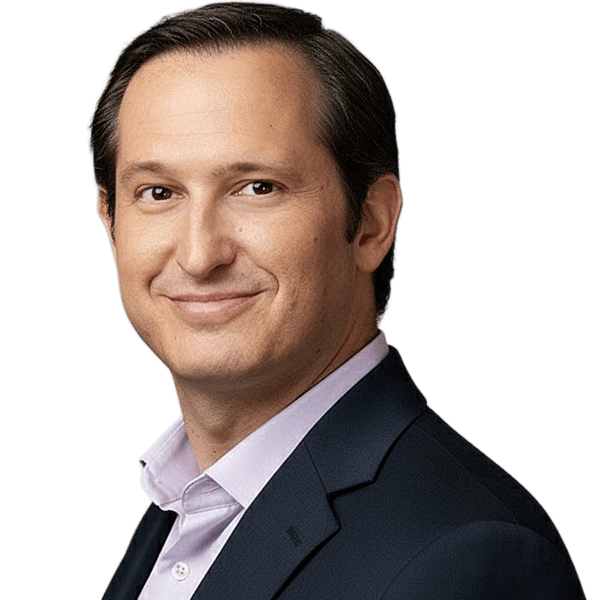
Jason Robins is the co-founder, CEO and Chairman of DraftKings, the Boston sportsbook, online casino and fantasy sports company. He has run DraftKings since co-founding it in December 2011, and became Chairman when it went public in April 2020. Through a special class of 10-vote shares, he controls about 88% of its voting power.
Under Robins, DraftKings grew from a fantasy sports start-up into New Jersey’s first legal online sportsbook in 2018. In 2026, he’s pushing into prediction markets, which let users trade on the outcomes of real events. He’s also defending the company’s promotions after a New York Times investigation.
Our US gambling executive profiles also cover both of his DraftKings co-founders.
About Jason Robins
Jason Robins is a data-focused founder who turned a childhood fantasy sports habit into a public company. Born in Stanford, California, he once played in more than 200 fantasy leagues in a single year as a kid. He told Sports Business Journal in 2015 that he’d always been interested in data and analytics.
Robins attended Duke University, where he earned a B.S. in economics and computer science with a minor in math. After Duke, he joined Capital One in 2003, working in marketing and analytics. In 2008, he moved to Vistaprint, the online design and marketing firm.
DraftKings’ 2026 proxy statement lists his age as 45. Outside DraftKings, he sits on the board of Extend, Inc., which sells extended warranty contracts for consumer products.
Between 2020 and 2023, he was also a director of two special purpose acquisition companies (SPACs). A SPAC is a listed shell company that raises money to merge with a private business and take it public.
His recognition includes Fortune’s 40 Under 40 list in 2015, when he also appeared on the magazine’s October cover. Sports Business Journal named him to its Forty Under 40 class the same year. In 2022, The Boston Globe ranked him 12th on its Tech Power Players list.
Jason Robins’ Role at DraftKings
Jason Robins holds two jobs at DraftKings: he runs the business as CEO and leads the board as Chairman.
| Detail | Jason Robins at DraftKings |
|---|---|
| Title | Chief Executive Officer and Chairman of the Board |
| Company | DraftKings Inc. (Nasdaq: DKNG) |
| Headquarters | Boston, Massachusetts |
| Co-founded | December 2011, with Matt Kalish and Paul Liberman |
| CEO since | The company’s founding in December 2011 |
| Chairman since | April 2020 |
| Voting power | About 88.3%, as of March 2026 |
| 2025 pay | $1 salary; $22.6 million in total, mostly stock awards |
DraftKings’ proxy statement says Robins oversees strategy and operations and drives financings and strategic deals. It also credits him with leading the company’s work with lawmakers on fantasy sports, sports betting and online casino laws.
His control comes from a dual-class share setup. Robins holds all 393 million Class B shares, and each one carries 10 votes. That gives him about 88.3% of total voting power, even though he owns just 2.1% of the Class A shares.
In practice, his votes decide board elections and other shareholder votes. For that reason, Nasdaq treats DraftKings as a “controlled company,” exempt from some board independence rules.
The founding trio is no longer all in the executive suite. Co-founder Matt Kalish stepped down as President of DraftKings North America on March 31, 2026, but stayed on the board. Fellow co-founder Paul Liberman remains President, Operations, and a director.
As of August 2026, DraftKings ran mobile sports betting in 27 states, Washington, D.C., and Puerto Rico. Its daily fantasy platform was available in 44 states.
Jason Robins’ Career and Professional Background
Jason Robins’ career has two parts: about eight years in corporate marketing and analytics, then nearly 15 years running DraftKings. The table lists each role, newest first.
| Dates | Role | Company |
|---|---|---|
| Apr 2020 to present | Chief Executive Officer and Chairman of the Board | DraftKings Inc. (Nasdaq-listed) |
| Dec 2011 to Apr 2020 | Co-founder and Chief Executive Officer | DraftKings (private company) |
| 2008 to DraftKings’ founding | Marketing and analytics roles | Vistaprint |
| 2003 to 2008 | Marketing and analytics roles | Capital One |
From Vistaprint to a Spare-Bedroom Start-Up
At Vistaprint, Robins worked alongside Matt Kalish and Paul Liberman, his future co-founders. In the winter of 2011, Kalish pitched him an idea. Fantasy contests would last a day or a week, not a whole season.
That idea became daily fantasy sports (DFS), where players pick real athletes for a single day or week. They win cash prizes based on how those athletes perform. The founders set up DraftKings in December 2011 and launched the product in 2012, starting out of a spare bedroom.
Daily Fantasy Growth and the 2015 Legal Fight
In 2013, DraftKings became the first DFS company to sign a partnership with Major League Baseball. By 2015, it had bought smaller rivals DraftStreet and StarStreet. Fortune reported that year that DraftKings had raised $375 million at a valuation near $1.5 billion.
Fast growth and a heavy TV ad push brought regulators in. In November 2015, New York Attorney General Eric Schneiderman sent DraftKings and FanDuel a cease-and-desist letter. He argued that paid DFS contests were illegal gambling.
The companies sued, then agreed in March 2016 to stop taking New York players until the state legalized DFS. New York passed a DFS law later that year. In October 2016, DraftKings and FanDuel each paid $6 million to settle the state’s false advertising claims.
First to Market in New Jersey
In May 2018, the US Supreme Court struck down PASPA, a 1992 federal sports betting ban. Before the ruling, that law had kept legal sports betting largely confined to Nevada. DraftKings had already spent almost a year preparing a sportsbook app.
DraftKings soft-launched its sportsbook app in New Jersey on August 1, 2018, on an invite-only basis. On August 6, it became the first company to offer legal online and mobile sports betting in the state. It operated through a partnership with Resorts Casino Hotel in Atlantic City, and Robins called the launch a new chapter.
Going Public and Buying Growth
On April 23, 2020, Robins closed a three-way merger with SPAC Diamond Eagle Acquisition Corp. and betting technology supplier SBTech. DraftKings shares began trading on Nasdaq as DKNG the next day. Diamond Eagle’s Harry Sloan became Vice Chairman, a seat he still held in 2026.
SBTech gave DraftKings its own betting platform. The company now calls itself the only US-based vertically integrated sports betting operator. In plain terms, it builds and runs its own betting technology.
Next came Golden Nugget Online Gaming, which DraftKings bought in an all-stock deal that closed on May 5, 2022. The deal carried an implied equity value of about $1.56 billion. As part of it, Golden Nugget owner Tilman Fertitta joined the DraftKings board.
In May 2024, DraftKings completed its $750 million purchase of Jackpocket. Jackpocket is a lottery courier app that orders official state lottery tickets for customers. Then, in November 2025, ESPN named DraftKings its exclusive Official Sportsbook and Odds Provider, effective December 1, 2025.
The Prediction Markets Pivot
Since late 2025, Robins has steered DraftKings into prediction markets. Unlike sportsbooks, these exchanges answer to a federal regulator rather than state gaming boards.
In October 2025, DraftKings bought Railbird, an exchange licensed by the Commodity Futures Trading Commission (CFTC). The CFTC is the federal regulator for futures and event contracts. DraftKings Predictions followed in December 2025.
The move split DraftKings from parts of the industry. In November 2025, it withdrew its pending Nevada license applications after state regulators objected to its prediction markets plans. That same month, it resigned from the American Gaming Association, the industry’s main trade group.
By August 2026, DraftKings’ “Super App” was live nationwide, combining its main products in one app. Its in-house exchange, DKeX, then filed football contracts ahead of the NFL season. On the Q2 2026 earnings call, Robins said more than 600,000 customers had used Predictions so far that year.
Q2 2026 revenue fell 5% to $1.44 billion, which DraftKings blamed on customer-friendly sports results and promotional spending. Even so, Robins said Predictions was “growing faster than we anticipated.” DraftKings also kept its 2026 revenue guidance of $6.5–6.9 billion.
Legal and Regulatory Issues Under Jason Robins
Jason Robins’ fast-moving style has drawn regular pushback since the New York fight, from customers as well as regulators. The main episodes since 2024 are listed below, oldest first.
- August 2024 – Robins announced a “gaming tax surcharge” on winning bets in high-tax states such as Illinois and New York. DraftKings dropped it 12 days later, on August 13, after customer backlash. FanDuel had just said it wouldn’t add a similar charge.
- September 2024 – The SEC fined DraftKings $200,000 under its fair disclosure rule, Regulation FD. A PR firm had posted unreleased growth figures on Robins’ personal X and LinkedIn accounts before an earnings release.
- September 19, 2026 – The New York Times published an investigation into DraftKings’ promotions. It reported that a machine-learning model steered offers toward customers likely to lose more. DraftKings denied targeting customers based on losses or signs of problem gambling.
- September 2026 – The Massachusetts Gaming Commission said it would review how DraftKings and other licensed operators use AI. Massachusetts rules bar AI-driven promotions known or expected to make a platform more addictive.
- September 30, 2026 – A West Virginia customer filed a proposed class action in federal court in Boston. The suit cites the Times report heavily. Robins called the report “slanderous” in a TheWrap interview released earlier that day.
As of October 12, 2026, the class action is at an early stage. None of its claims has been tested in court, and the Massachusetts review is still open. Our coverage of the DraftKings AI lawsuit explains the allegations in more detail.
Jason Robins’ Expertise in US Sports Betting and Online Casino
Jason Robins’ expertise sits in five areas, each tied to a stage of DraftKings’ growth.
| Area | What it covers | Where he built it |
|---|---|---|
| Data-driven product and marketing | Using customer data to shape products, pricing and promotions | Capital One, Vistaprint, DraftKings DFS |
| State market launches | Getting licensed and live quickly when a state legalizes betting | New Jersey in 2018, then state-by-state expansion |
| Deals and capital markets | Raising money and buying companies to add products and customers | 2020 SPAC listing, Golden Nugget Online Gaming, Jackpocket, Railbird |
| Policy and regulation | Working with lawmakers on fantasy sports, sports betting and online casino laws | DraftKings’ government affairs work, per its proxy statement |
| Prediction markets | Running a federally regulated trading product next to state-licensed betting | DraftKings Predictions and DKeX, 2025 to 2026 |
One thread runs through that list: moving into new markets before the rules are fully settled. DFS in 2012 and prediction markets in 2025 both followed that pattern.
Why Jason Robins’ Experience Matters to US Casino Players
Jason Robins’ decisions shape what millions of US bettors see in a betting app, from game menus to bonus offers. Three parts of his record matter most to US casino players.
First, DraftKings Casino is live in New Jersey, Pennsylvania, Michigan, West Virginia and Connecticut. The Golden Nugget Online Gaming brand runs in four states. Players outside those states can check our state-by-state casino guide to see what’s legal where they live.
Second, promotions are a big part of how DraftKings wins and keeps customers, and they’re now under scrutiny. The Times report and the Boston lawsuit both focus on how the company chose who got bonuses. If offers push you to bet more than planned, use the app’s deposit limits or our responsible gambling guide.
Third, prediction markets work differently from a sportsbook, even when the screen looks similar. Prices move as other users trade, and access depends on your state. Robins has warned that casual traders on these platforms often face professional bettors and trading firms, not other fans.
One limit is worth stating plainly. Robins’ record is about running a licensed operator, not testing casinos as a player. Treat it as context, and check any site’s terms, limits and licensing yourself.
Frequently Asked Questions About Jason Robins
Here are quick answers to common questions about Jason Robins.
Who Is Jason Robins?
Jason Robins is the co-founder, CEO and Chairman of DraftKings, the Boston sportsbook, online casino and fantasy sports company. He co-founded it in December 2011 with Matt Kalish and Paul Liberman. Before that, he worked in marketing and analytics at Capital One and Vistaprint. He studied economics and computer science at Duke University.
How Did Jason Robins Start DraftKings?
Jason Robins started DraftKings with two Vistaprint colleagues, Matt Kalish and Paul Liberman. Kalish pitched the idea of short fantasy contests in the winter of 2011. The trio set up the company that December and launched it in 2012, with Robins as CEO from the start. He became Chairman when DraftKings went public in April 2020.
How Much of DraftKings Does Jason Robins Control?
Jason Robins controls about 88.3% of DraftKings’ total voting power, according to its March 2026 proxy statement. He holds all 393 million Class B shares, which carry 10 votes each. His economic stake is much smaller, at about 2.1% of the Class A shares. As a result, Nasdaq treats DraftKings as a controlled company.
What Did Jason Robins Do Before DraftKings?
After Duke, Jason Robins joined Capital One in 2003, working in marketing and analytics. In 2008, he moved to Vistaprint, the online design and marketing firm. There, he worked alongside Matt Kalish and Paul Liberman, who became his co-founders. He left to start DraftKings with them in December 2011.
Is Jason Robins Still CEO of DraftKings?
Yes, Jason Robins was still CEO and Chairman of DraftKings as of October 2026. He has led the company since co-founding it in December 2011. His current focus is DraftKings Predictions, as the company faces a Massachusetts review and an AI-related class action. Executive roles can change, so check DraftKings’ latest announcements.