
Sports betting has always had a social side, from ancient Romans wagering on chariot races to modern fans trading picks over text. What’s changing now is where that conversation actually happens.
Bettors have long shared parlays in group chats, on Discord, and on X, then had to manually rebuild the same bet inside their own sportsbook app. Social sportsbook betting apps are closing that gap by building the conversation directly into the product.
FanDuel’s Community Feed lets users see other players’ bets and add them to their slip with one tap. DraftKings’ Social Betting Groups let users track friends, chat, and compete on a leaderboard without leaving the app.

Editorial Statement: We independently review and select all gambling operators. While we may earn commissions from affiliate links or paid placements, these never influence our editors’ opinions or evaluations. Every platform is assessed against our own standards, and we highlight both strengths and shortcomings, regardless of any commercial relationship.
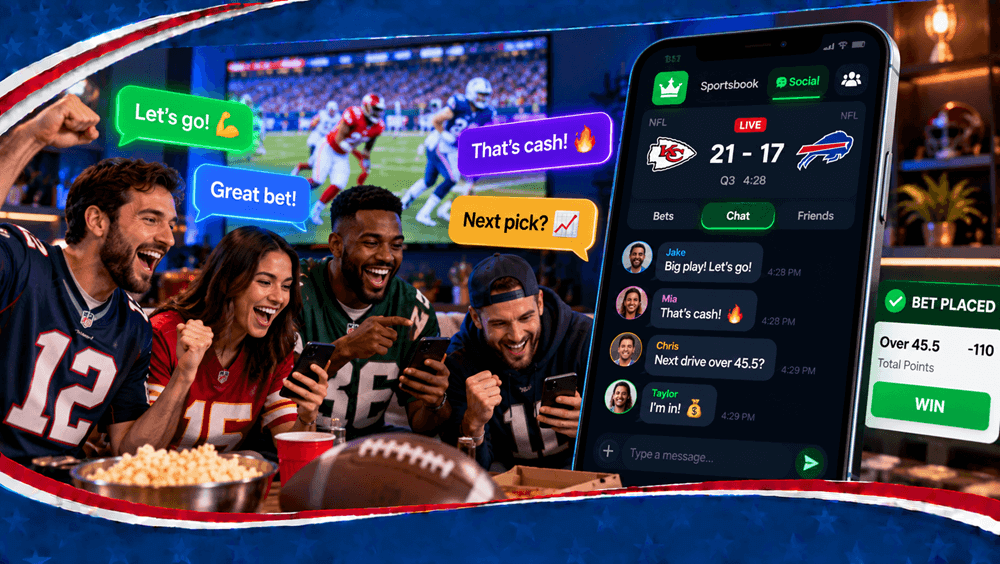
How Social Sportsbook Betting Apps Are Changing the Wager Itself
The table below rounds up how different platforms are building social features directly into their betting products.
| Operator | Social Feature | What It Does |
| FanDuel | Community Feed | Shows other users’ bets and lets players add them to their slip in one tap |
| DraftKings | Social Betting Groups | Lets users form groups, track friends’ bets, chat, and compete on a leaderboard |
| FanDuel | Pass the Leg | Limited-time promo letting friends and family each add one leg to a shared parlay |
| FanDuel x Real | In-app odds inside a social sports app | Places betting markets directly inside an app where fans already talk about games |
| Slips | In-app group chat wagers | Lets friends create, share, and settle their own peer-to-peer bets inside one chat |
Source: Gambling Insider reporting on sportsbook social features, September 2026.
Peer-to-peer platform Slips takes a different approach entirely, letting friends create their own bets and settle them within a shared in-app chat rather than through a traditional sportsbook menu.
Why Operators Are Building Social Features into Betting Apps
Plannatech CEO Adam Bjorn said community has become central to how betting products compete for attention. He noted that sharing bets and following other bettors has long been part of betting culture outside the US, through forums, tipster groups, and messaging apps, and that US operators are now bringing that behavior inside their own platforms.
Bjorn described the underlying motivation simply: “Everything today is about community.” He added that social features function primarily as an engagement and retention tool, since sportsbooks compete for a user’s attention against every other app on their phone, not just rival betting products.
From his perspective, the social behavior itself is not new. What has changed is that operators can now keep that activity inside their own ecosystem instead of losing users to outside platforms.
Betting Feeds Are Changing How Bettors Find Wagers
A traditional sportsbook menu works best when a bettor already knows what they want. A betting feed flips that model, surfacing wagers a user might never have searched for on their own.
Odditt co-founder and CEO Matt Bresler told Gambling Insider that most casual bettors do not open an app with a specific market in mind. He said feeds shift the experience from search to discovery, presenting a parlay built around a storyline or matchup and letting the user decide whether it interests them, rather than requiring them to hunt for it themselves.
Copying a Bet Now Takes One Tap Instead of a Rebuild
Before in-app social features existed, recreating a friend’s parlay from a group chat meant manually finding the same markets in your own sportsbook. Bjorn described the current shift as removing the friction between inspiration and action, turning what used to be a multi-step rebuild into a single tap.
Bresler said that shift also changes the role of the bet slip itself. When a feed can move a wager directly into a user’s cart, the content becomes the actual product, with the sportsbook functioning more like a checkout step.
Fewer Steps Can Mean Less Time to Reconsider a Bet
Business psychology professor Dr. Elizabeth Schwab told Gambling Insider that removing steps between seeing a bet and placing it can influence decision-making. She compared it to saved payment information making a purchase easier to complete than manually pulling out a card.
Schwab explained that added friction can give people a moment to slow down and think more logically before acting, though that same friction may not change the outcome once someone has already fully committed to placing a bet.
Watching Other Bettors Can Shape Your Own Wagers
Schwab said people often look to others to gauge what counts as normal behavior, especially when they feel uncertain about a decision, a pattern also seen across social media platforms generally. Perceived expertise can amplify that effect even among strangers, and shared betting activity can reduce the uncertainty a bettor feels about taking a risk in the first place.
Academic research backs this up. A University of Washington study of 221 young adult sports bettors across 36 states found that beliefs about friends’ betting habits correlated with how much participants wagered over a two-week period. A separate Australian study of regular bettors found that nearly all participants reported betting more when friends were involved, with one describing real pressure to raise their usual stakes in a group setting.
Social Betting Features Raise New Responsible Gambling Questions
Bjorn argued that social betting can work as a safeguard as much as a risk, since friends often notice when someone is chasing losses or wagering more than usual and say something. He cautioned that this only helps when it does not turn into pressure to place bets someone cannot afford.
Bresler pushed back on the idea that fewer steps automatically create more risk, arguing the bigger factor is how a platform frames betting and what it offers users who may need help. In his view, a feed becomes risky mainly when it lacks context and offers no visible path to support.
What This Means for Sports Bettors
Social features can make it easy to copy a bet you see in a feed without pausing to consider whether it actually fits your own budget or strategy. Treat a friend’s parlay or a trending feed pick the same way you would treat any other tip: worth a look, not an instruction.
If you notice yourself wagering more when friends are watching or participating, that is worth paying attention to on its own, separate from whether any individual bet makes sense. Set a personal budget before you open a social feed, not after you see what everyone else is doing.
FAQs
What are social sportsbook betting apps?
Social sportsbook betting apps build community features like activity feeds, group chats, and shared leaderboards directly into the betting product. Examples include FanDuel's Community Feed, DraftKings' Social Betting Groups, and peer-to-peer platform Slips, which let users see, copy, or settle bets with friends inside the app itself.
How does FanDuel's Community Feed work?
FanDuel's Community Feed shows other users' placed bets and lets you add any of them directly to your own bet slip with one tap. It removes the extra step of manually finding the same markets after seeing a wager shared elsewhere.
Do social betting features make people bet more?
Research suggests social influence can affect wager size. A University of Washington study found that beliefs about friends' betting habits correlated with how much young adult bettors wagered. A separate study found bettors often reported placing larger wagers when betting alongside friends.
Are social betting features a responsible gambling risk?
Industry experts are divided on this point. Some argue social visibility can act as a safety net, since friends may notice and flag risky betting behavior. Others say the real risk depends on how a platform frames betting and whether it offers clear support options, not on the number of steps required to place a bet.
What is a betting feed, and how is it different from a normal sportsbook menu?
A betting feed surfaces wagers to you automatically, often based on trends, storylines, or other users' activity, rather than requiring you to search for a specific market. This shifts the experience from active searching to passive discovery, which can expose you to bets you weren't originally looking for.
How can I avoid overspending because of social betting features?
Set a personal betting budget before opening a social feed or group chat, rather than deciding in the moment based on what others are wagering. Treat shared bets as information rather than instructions, and pay attention if you notice yourself betting more specifically because friends are involved.