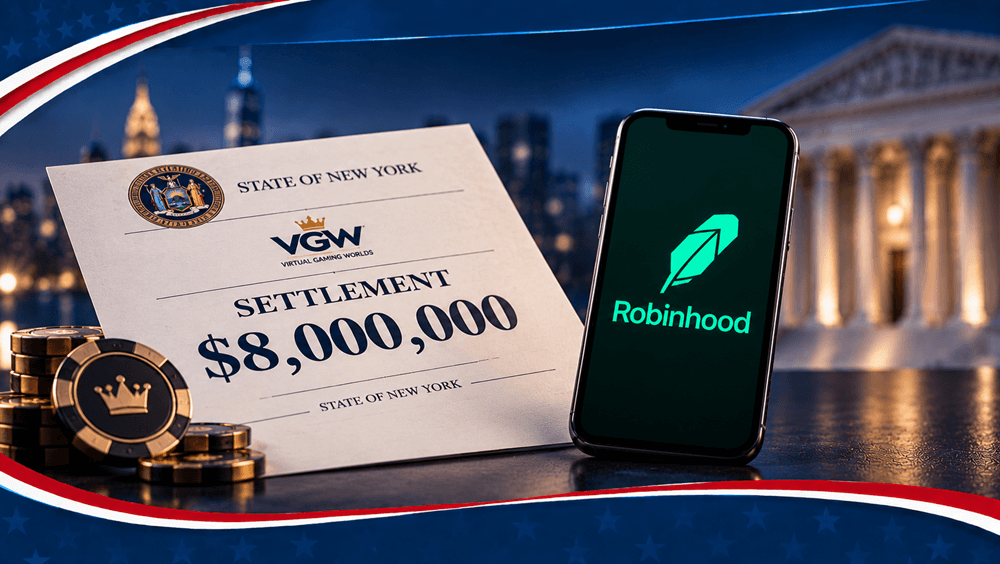
New York secured an $8 million settlement from VGW on Sept. 9 over its sweepstakes casino operations, closing out a long-running investigation into Chumba Casino, Global Poker, and LuckyLand Slots.
The same day brought a separate but related development: Robinhood filed a petition asking the U.S. Supreme Court to review a Ninth Circuit ruling on prediction markets, taking a different legal path than Kalshi, which asked the same court to rehear its case.
Two very different corners of the gambling industry, sweepstakes casinos and prediction markets, both landed in front of major legal decision-makers on the same day.

Editorial Statement: We independently review and select all gambling operators. While we may earn commissions from affiliate links or paid placements, these never influence our editors’ opinions or evaluations. Every platform is assessed against our own standards, and we highlight both strengths and shortcomings, regardless of any commercial relationship.
The VGW New York Settlement, Explained
New York Attorney General Letitia James announced the settlement following an investigation into VGW’s dual-currency sweepstakes model. The table below breaks down what the deal actually covers.
| Detail | What the Settlement Covers |
| Settlement amount | $8 million in disgorgement, restitution, penalties, and costs |
| Platforms named | Chumba Casino, Global Poker, and LuckyLand Slots |
| Alleged violations | Illegal gambling promotion, unlawful possession of gambling records, and repeated illegal acts under state law |
| Sweeps Coin structure | Investigators found players received about one Sweeps Coin per dollar spent, rejecting VGW’s free-coin defense |
| Player relief window | One year for eligible former NY customers to request redemption of Sweeps Coins held as of June 2, 2025 |
Source: New York Attorney General’s Office press release, Sept. 9, 2026.
According to the Attorney General’s Office, VGW offered Chumba Casino to New Yorkers starting in 2012, later adding Global Poker in 2016 and LuckyLand Slots in 2018. All three used Sweeps Coins that could be redeemed for cash or prizes.
James said the state’s gambling laws exist to protect residents, adding that the sweepstakes platforms posed a dangerous threat to New Yorkers and their financial and mental health.
The settlement follows a cease-and-desist letter James’ office sent in April 2025, after which VGW stopped offering Sweeps Coins to New York players. New York has since passed a law banning dual-currency sweepstakes casinos outright, joining roughly a dozen states that have taken action against the sector.
VGW Says the Settlement Isn’t an Admission of Guilt
VGW responded the same day, saying it welcomes the matter’s conclusion. The company pointed out that it voluntarily stopped allowing New York players to collect Sweeps Coins back in June 2025, ahead of the formal settlement.
VGW also highlighted language in the settlement agreement stating it is not intended as an admission of liability. The company said it will keep operating in New York through Gold Coins play only, its free-to-play currency that carries no cash redemption value.
Robinhood and Kalshi Split Paths After the Ninth Circuit Ruling
Kalshi has asked the Ninth Circuit to rehear its Nevada case with the full court, while Robinhood has gone a different direction, petitioning the Supreme Court directly to review the same underlying ruling on sports prediction markets.
Gaming attorney Daniel Wallach described the two moves as a coordinated approach, with Kalshi keeping the case alive at the circuit level while Robinhood tries to fast-track Supreme Court review. Getting a case to the high court quickly could let justices weigh the Ninth Circuit’s ruling against a conflicting Third Circuit decision at the same time.
New Jersey has separately asked the Supreme Court to review that Third Circuit ruling, which reached the opposite conclusion from the Ninth Circuit on whether federal law preempts state gambling regulation.
The Ninth Circuit Ruling Is Already Reshaping Other Cases
Arizona officials are preparing to ask the court to vacate a May injunction that has blocked the state from enforcing its gambling laws against Kalshi’s sports contracts, arguing the Ninth Circuit’s ruling supports that outcome. Kalshi has said it will oppose the move while its own rehearing request is pending.
Underdog also entered the legal fight this week, suing regulators in Massachusetts, Ohio, Wisconsin, New Mexico, and Washington. The lawsuits followed Underdog surrendering its daily fantasy sports licenses in seven states and argue that federal commodities law preempts state gambling enforcement against its sports contracts.
What This Means for Sweepstakes Casino Players
If you held Sweeps Coins with Chumba Casino, Global Poker, or LuckyLand Slots in New York as of June 2, 2025, this settlement gives you a one-year window to request redemption if you never received VGW’s earlier phaseout notice.
More broadly, sweepstakes casinos face active legal challenges in roughly a dozen states, and the rules are shifting quickly. A platform operating in your state today is not a guarantee it will still operate there next year.
Anyone using a sweepstakes casino should periodically check whether their state has taken action against the model, and should not assume a familiar brand automatically remains available or compliant going forward.