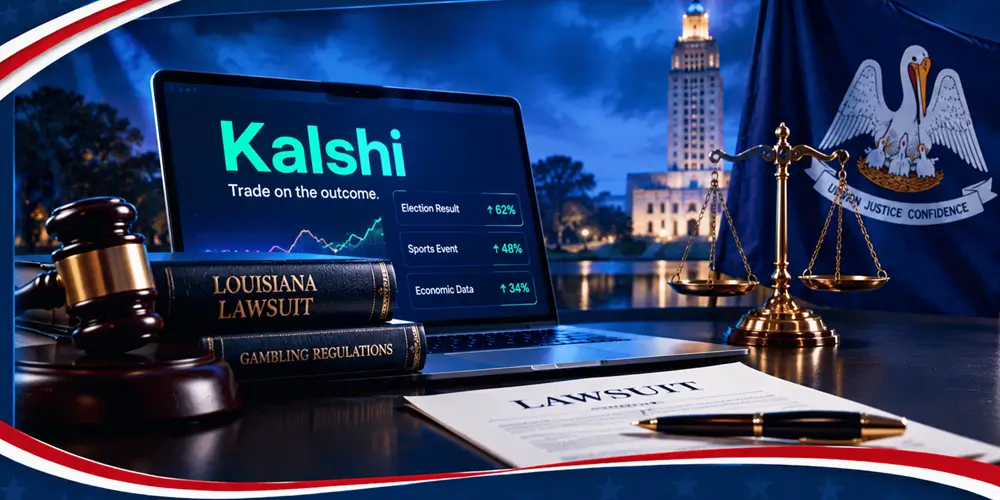
The Kalshi Louisiana lawsuit is a pre-emptive strike. On Oct. 23, 2026, the prediction market sued Louisiana’s governor, attorney general, and gaming regulators before any of them had taken formal action against it.
Kalshi asks a federal court to stop the state from enforcing its gambling laws against Kalshi’s sports event contracts. Louisiana’s position is that those contracts are sports wagering that requires a state license.
None of these claims has been decided. We explain what Kalshi argues, what the state has said, and why Louisiana’s new laws raised the stakes.

Editorial Statement: We independently review and select all gambling operators. While we may earn commissions from affiliate links or paid placements, these never influence our editors’ opinions or evaluations. Every platform is assessed against our own standards, and we highlight both strengths and shortcomings, regardless of any commercial relationship.
The Kalshi Louisiana Lawsuit at a Glance
The table below sums up the case as of Oct. 28, 2026.
| Detail | What the Complaint Shows |
| Filed | Friday, Oct. 23, 2026 |
| Court | US District Court for the Western District of Louisiana |
| Defendants | Gov. Jeff Landry, AG Liz Murrill, Gaming Control Board Chair Christopher Hebert, Gaming Division Director Dawn Himel, and the State Police Gaming Enforcement Division |
| What Kalshi wants | A temporary restraining order plus preliminary and permanent injunctions blocking enforcement against its sports event contracts |
| Core argument | Federal law gives the CFTC exclusive authority over its exchange, so Louisiana cannot regulate it |
| Louisiana’s position | Sports contracts are sports wagering and need a state license |
| Why it matters | First prediction market case in the Fifth Circuit |
Sources: SBC Americas, Yogonet, and WAFB reporting on the complaint, Oct. 26 to 27, 2026.
Why Kalshi Sued Before Louisiana Acted
Kalshi says Louisiana officials have made clear that they plan to act. The complaint points to public statements, court filings, and a December 2025 letter from the Gaming Control Board as proof that enforcement is coming.
That letter went to the state’s licensed sportsbooks. In it, board chair Christopher Hebert warned that offering prediction markets on sports breaks state law and could affect their gaming licenses.
Hebert wrote that “it is the board’s position that such activities constitute sports wagering under Louisiana law.” He added that state law treats exchange wagering as a form of sports wagering.
Kalshi says officials have given no assurance they will hold off. A preemptive suit lets it pick the venue and ask a judge to act before the state files its own case.
Louisiana’s New Gambling Laws Raise the Stakes
Two bills signed in May 2026 took effect on Aug. 1. House Bill 53 upgrades several gambling crimes, including what the state calls gambling by computer, to racketeering offenses that carry up to 50 years in prison.
House Bill 883 made it a crime to run dual-currency sweepstakes casinos and social gaming platforms in the state. It also widened the definition of gambling by computer.
Lawmakers aimed both bills mainly at illegal casinos and sweepstakes sites. Kalshi’s complaint says the laws still threaten it, because the attorney general can seek injunctions and a court could shut down websites and freeze assets.
Kalshi adds that those powers could reach more than the company itself, including payment processors, geolocation providers, and media affiliates.
Kalshi’s Federal Argument and Louisiana’s Response
Kalshi says it is a federally regulated exchange under the Commodity Futures Trading Commission. In its view, federal law gives the CFTC exclusive authority over that kind of platform, so states cannot regulate it.
The company also points to a carve-out in Louisiana’s own statute. Louisiana’s gambling-by-computer law says it does not restrict trading in futures, options, and similar instruments on a commodities exchange.
Kalshi further argues that it could not follow Louisiana’s licensing rules even if it applied. It says state requirements would clash with federal ones, including the CFTC’s rule that an exchange give eligible participants impartial access.
Louisiana’s side is simpler. The state says sports betting needs a license, and its law lists exchange wagering as sports wagering. The gaming board told reporters it does not comment on matters before a court, and the governor’s and attorney general’s offices did not respond to SBC Americas by publication.
How the Kalshi Louisiana Lawsuit Fits the Wider Fight
The case pushes the prediction market fight into the Fifth Circuit for the first time. Similar disputes are already moving through the Third, Sixth, and Ninth Circuits.
Kalshi can point to one recent win. Earlier in October, a federal judge in Illinois ruled that Kalshi and Coinbase answer to the CFTC rather than the state gaming commission.
It also faces new pressure elsewhere. Utah sued Kalshi and six related entities in October, seeking to stop it from offering contracts to residents and to recover alleged profits.
Baton Rouge attorney Franz Borghardt, who is not involved in the case, told local reporters the dispute could eventually reach the US Supreme Court. He expected a quick decision on whether Kalshi can keep operating for now, with a longer fight over the bigger question.
What the Kalshi Louisiana Lawsuit Means for Bettors
Nothing has changed for users yet. No court has ruled, and no enforcement action has been filed. Still, access to prediction markets can shift quickly while cases like this play out.
Louisiana residents who want a clearly legal option for sports betting can use a sportsbook licensed by the state gaming board. Our guide to the best sports betting sites covers licensed operators.
If you trade on a prediction market, avoid keeping more money on the platform than you are comfortable having tied up. Check the platform’s current status in your state before you deposit, and expect the rules to keep changing.
FAQs
What is the Kalshi Louisiana lawsuit about?
Kalshi sued Louisiana officials in federal court on Oct. 23, 2026, asking a judge to block the state from enforcing its gambling laws against Kalshi's sports event contracts. Kalshi says federal law gives the CFTC exclusive authority. Louisiana says sports contracts are sports wagering that requires a state license.
Why did Kalshi sue before Louisiana took action?
Kalshi says Louisiana officials have shown a clear plan to act, citing statements, court filings, and a December 2025 gaming board letter. The company says no one has promised to hold off. Suing first lets Kalshi ask a federal court to step in before the state files its own case.
Who is named in the Kalshi Louisiana lawsuit?
The defendants are Gov. Jeff Landry, Attorney General Liz Murrill, Gaming Control Board Chair Christopher Hebert, Gaming Division Director Dawn Himel, and the Louisiana State Police Gaming Enforcement Division. The case was filed in the US District Court for the Western District of Louisiana.
What are Louisiana's new gambling laws?
House Bills 53 and 883 took effect on Aug. 1, 2026. HB 53 upgrades gambling crimes, including gambling by computer, to racketeering offenses with penalties of up to 50 years. HB 883 criminalizes dual-currency sweepstakes and social gaming platforms and widens the definition of gambling by computer.
Can Louisiana residents still use Kalshi?
As of Oct. 28, 2026, nothing in the reporting shows that Kalshi has been blocked in Louisiana. No court has ruled and no enforcement action has been filed. That could change quickly, so check the platform's current status before you deposit.
Could the Kalshi Louisiana lawsuit reach the Supreme Court?
It could. Baton Rouge attorney Franz Borghardt, who is not part of the case, said it may eventually reach the US Supreme Court. Similar disputes are already in the Third, Sixth, and Ninth Circuits, and this is the first one in the Fifth Circuit, so conflicting rulings are possible.