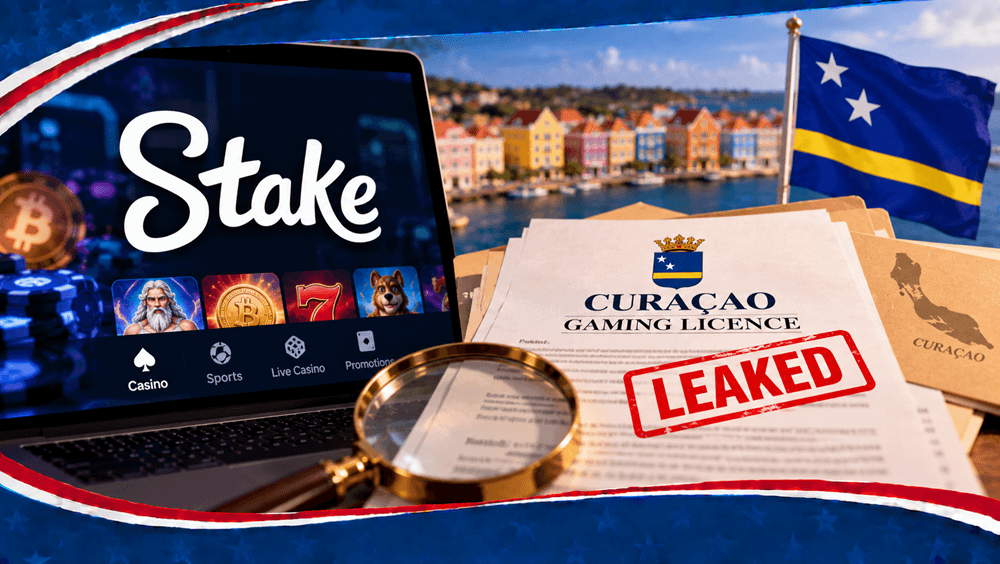
Leaked Curacao Gaming Authority records show that Medium Rare N.V., the company behind crypto casino Stake, received its gambling license while regulators still had open questions about who actually owned the business.
Stake is one of the best-known names in crypto gambling, built into a multibillion-dollar business with rapper Drake as its most visible public face. The leaked records raise questions about how thoroughly its ownership was vetted before it received the license letting it operate.
The documents came from a hacker and researcher named Lilith Wittmann, who obtained tens of thousands of confidential files from the CGA’s licensing system and published the findings alongside Follow the Money and other outlets on Sept. 22.

Editorial Statement: We independently review and select all gambling operators. While we may earn commissions from affiliate links or paid placements, these never influence our editors’ opinions or evaluations. Every platform is assessed against our own standards, and we highlight both strengths and shortcomings, regardless of any commercial relationship.
Timeline: How the Curacao Leak Stake License Story Unfolded
The table below lines up the key dates in the licensing timeline and the leak itself.
| Date | What Happened |
| Jun. 9, 2025 | Curacao Gaming Authority conditionally grants Medium Rare N.V. a gambling license |
| Same date | Medium Rare is given five weeks to clarify its ownership structure and ties to Stake’s founders |
| Unknown | Whether Medium Rare met the five-week deadline is not confirmed in the leaked records |
| Sept. 22, 2026 | Hacker and researcher Lilith Wittmann’s leak is published as the Casino Secrets investigation |
| Sept. 22, 2026 | The CGA issues a public statement defending its licensing procedures |
Source: Casino Secrets investigation and Follow the Money reporting, September 2026.
What the Leaked Licensing Report Actually Found
An internal CGA report identified Mladen Vuckovic as Medium Rare’s sole beneficial owner and CEO. The same report acknowledged that Stake founders Ed Craven and Bijan Tehrani were widely known publicly as the people behind the platform, despite neither being disclosed in the license application itself.
The report flagged that Medium Rare’s true beneficial ownership, along with its business and contractual ties to Craven, Tehrani, and several companies connected to Stake, remained unclear at the time reviewers evaluated the application.
Despite that uncertainty, the report concluded that a license could still be granted subject to specific conditions. Medium Rare was given five weeks from the license date to explain its relationships with Craven, Tehrani, and the connected companies, along with the agreements governing its use of the Stake brand and domain.
Separately, Follow the Money reported that Curacao officials had questioned whether Vuckovic was truly Stake’s sole owner after identifying loans and payments connecting Craven- and Tehrani-linked companies to the business.
How the Curacao Gaming Authority Has Responded
The CGA has not disputed the core finding that it granted licenses before fully resolving ownership questions. In a statement to Follow the Money, the regulator said it chose to let companies meet certain requirements gradually rather than all at once, and that a licensing question or uncertainty does not automatically trigger a refusal or shutdown.
In a separate Sept. 22 press release addressing the leak, the CGA said it had followed robust internal procedures in performing due diligence of its applicants. The regulator also cautioned against drawing conclusions from individual leaked documents viewed outside the context of a complete application file.
The available records do not show whether Medium Rare ultimately met its five-week deadline to clarify its ownership structure.
What This Means for Stake and Other Crypto Casino Users
This leak adds to a broader pattern worth keeping in mind: offshore licensing bodies like Curacao’s do not apply the same scrutiny US state gaming regulators use, and this case shows regulators there can grant a license while real ownership questions remain open.
None of this means Stake is operating illegally under Curacao law, since the CGA maintains its process allows phased compliance. It does mean players relying on an offshore license as a sign of trustworthiness should understand how much uncertainty that license can still contain.
For US players specifically, the bigger point stands regardless of this story’s outcome: Stake and similar crypto casinos hold no US state license, so no US regulator investigates ownership questions like these on a player’s behalf at all.